That recent post about translation means that this post at Reactor caught my eye: Five Stories About Translation and the Power of Languages
There’s one book in this post that I’ve read:
Turning Darkness Into Light by Marie Brennan
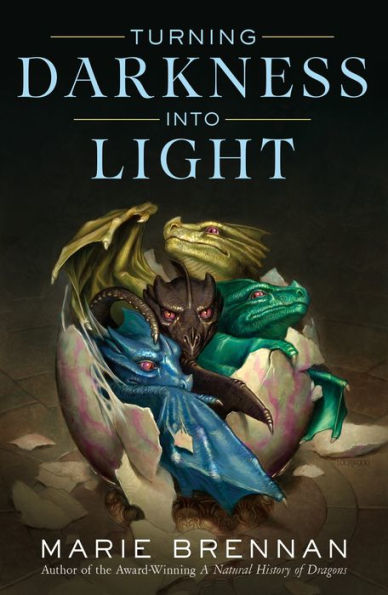
When Lord Gleinheigh recruits Audrey to decipher a series of ancient tablets holding the secrets of the ancient Draconean civilization, she has no idea that her research will plunge her into an intricate conspiracy, one meant to incite rebellion and invoke war. Alongside dearest childhood friend and fellow archeologist Kudshayn, Audrey must find proof of the conspiracy before it’s too late.
I really enjoyed the Lady Trent series, and I liked this book as well, though I found some elements of the series somewhat implausible. Nevertheless, sure, great series, and I did like this book. Here’s a tip: coloring your baby dragons in bright primary colors that totally match the dragons from Pern is going to cause a lot of your readers to feel your story should be Pern adjacent in some way. Also, these are not realistic colors for real animals MOST of the time, though I grant that some snakes do have surprising color variation.
Here’s a bit from a review of Turning Darkness into Light:
The translations are beautifully done and the scholarly exploration of the ancient religion compared with the modern variant is perfectly achieved, with the mythological stories so well written, it was a struggle at times to remember they were a fantastic conceit nested within a novel. The initial pacing is leisurely, but once the enormity of what is going on began to emerge, I simply couldn’t put this one down. While the theme of prejudice and bigotry was all too evident, the theme that caught my attention, was the way that intellectual arrogance is also a snare that caught most of the main characters in some way.
Oh, the above is part of a review by Sjhigbee, whom I’m familiar with because I’ve checked out her blog Brain Fluff from time to time. She wrote a nice review of Tuyo a few years ago. Regardless, good book.
How about the other books from this Reactor post? One is a short story, which is available online:
“A Pale Horse” by M Evan MacGriogair
The world is going to end. Our protagonist watches the horizon over the waves, looking for something, though she’s not sure what, as she thinks about the silences in the world, the fire alight in the Amazon, the species going extinct. As she heads home, she spots a car window with a phrase scribbled across it, reading “seeking a friend for the end of the world,” along with words from a language she was just thinking about. She writes back with her number and receives a sound file, a piece of music that seems to reflect a deep understanding of what she’s been looking for. In return, she sends the stranger a video of the view from her window.
So begins an exchange in recording and sharing the beauty of the world. It’s a beauty that infuses pictures and music and language, connecting people without needing meaning, offering a way to preserve the world, its sights, its music, its languages. I have read many short stories about both beauty and the end of the world, but I have never read something so deeply immersive, so gentle, so optimistic, something whose prose has the feeling of gauzy curtains in the summer or a hazy winter’s walk. Beautiful.
Here’s the first bit of the story —-
Thig crìoch air an t-saoghal ach mairidh gaol is ceòl.
Come the end of the world, love and music will endure.
She sits by the water’s edge, listening for a song to prove that point.
She came out here to the edge of Loch Fada to see…something.
All she sees is water and hills.
There is only the wind in her ears, only the lapping of the waves on the beach against rounded rocks. There are no words to weave music from here. And love left a long time ago.
The sun is about to set and take with it the remaining heat of the day like a cloak it wraps around itself through the night, leaving only the moonlight to promise tomorrow’s dawn. She does not notice the chill tonight. The cold does not touch her lately.
She thinks as she walks back up the beach to her car that she has turned to ash and failed to notice her own immolation. Or perhaps sea glass, tossed against the sand so long it has lost its shine. People like sea glass. She herself used to collect it, hold it in her hand until her skin warmed its surface. Nice, he’d say, and then he’d turn away, back to his phone, back to the endless demands of Reddit and the scroll like an anchor that never finds the shoal.
Dulled and blunted. That’s her after years of being sanded down.
Across the planet, the Amazon is burning.
She thinks it is strange that so large a piece of Earth could be on fire without the smell of smoke reaching her nose even here, on a Scottish beach thousands of miles from Braisil. She looks to the southwest as if smoke will appear like an apocalyptic smudge on the horizon, but it doesn’t.
When she turns back, there is a gleaming white horse on the beach, one hoof nudging a clump of seaweed. The sight gives her heart a thump. A water-horse, an each-uisge—for a moment, it could be. It is incandescent in the sun’s dying light. A mythical being, so alive she thinks she could feel its warmth if she put out her hand.
***
Nice imagery. You can click through if you would like to read the whole thing.
Meanwhile, I’m surprised to see a post about translation that doesn’t mention Embassytown.
In the far future, humans have colonized a distant planet, home to the enigmatic Ariekei, sentient beings famed for a language unique in the universe, one that only a few altered human ambassadors can speak. Avice Benner Cho, a human colonist, has returned to Embassytown after years of deep-space adventure. She cannot speak the Ariekei tongue, but she is an indelible part of it, having long ago been made a figure of speech, a living simile in their language. When distant political machinations deliver a new ambassador to Arieka, the fragile equilibrium between humans and aliens is violently upset. Catastrophe looms, and Avice is torn between competing loyalties: to a husband she no longer loves, to a system she no longer trusts, and to her place in a language she cannot speak—but which speaks through her, whether she likes it or not.
I didn’t quite feel this book worked, but I thought it was very interesting, engaging at the intellectual language more than the emotional level.
Of course one should really think of Foreigner, until recently my very favorite SF series ever. Maybe it still is despite bobbles in the latest few books. Regardless, Bren is of course a translator — that’s his main role to begin with, though later, of course, his job expands a bit. Watching him establish communication with the other nonhuman species — I think that happens in the 6th book, Explorer — is one of my favorite parts.
Oh, and how about Hellspark by Janet Kagan? What a wonderful story this is. As a murder mystery, it’s okay. As a book about people and trying to understand nonhumans, it’s top-notch. Delightful AI computer, one of my favorite characters in the story.
And there’s Project Hail Mary by Weir. I liked it a lot, though not as much as I liked The Martian.
Honestly, now that I pause to think about it, there seem to be A LOT of SFF novels where translation is a major plot element — more than I thought to start with. It only took a few minutes to think of the above. Instead of a post about five novels and stories, it looks perfectly possible to do a post about ten, or twenty. Probably more.
If you can think of an SFF novel where language and translation are super important, drop it in the comments! I bet there’s a bunch I haven’t thought of!
Please Feel Free to Share:


Suzette Haden Elgin’s Native Tongue! It’s about translation (between human language and extremely alien languages) and language creation.
I haven’t read it, but I think Babel by RF Kuang has a magic system that is based on translation?
Also the movie Arrival is based on a short story by Ted Chiang (which I also haven’t read, but saw the movie. Protagonist is a linguist brought in to figure out how to communicate with aliens)
whoops, I see Babel is mentioned in the linked article.
Ted Chiang’s “Stories of Your Life,” the basis for Arrival, is indeed an example of a very alien language from ETs who don’t experience reality the way humans do.
Jack Vance’s novel The Languages of Pao turns in large part on the hypothesis that language affects thinking.
The rather obscure novel Manhattan Transfer by Johyn Stith isn’t about translation, but does include a set of nicely handled scenes where a linguist is building up a translation database with a group of aliens.
I recently read Remnant Population by Elizabeth Moon. I had previously read all her other SF and Fantasy series, but only liked the Vatta series enough to reread. Remnant Population was the last one I read, and turns out to be my favourite. It starts out very slow paced. The protagonist is an old woman who chooses to stay behind when the rest of her colony is forced to evacuate by the corporation that owns the planet. Translation is a major theme in the 2nd half of the book. I found this story much more thoughtful and emotionally rewarding than Moon’s other books.